
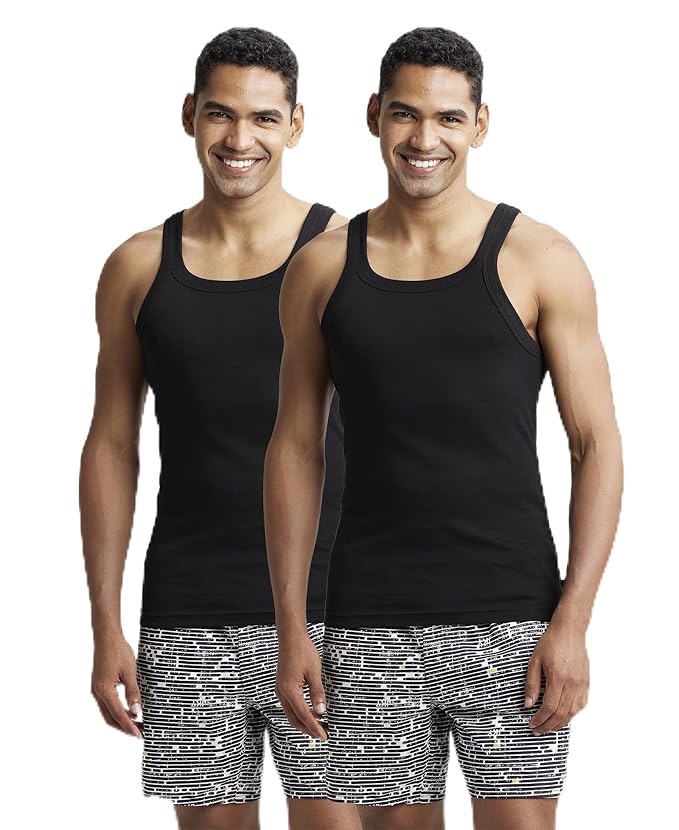

The Zone Collection offers vibrant one-of-a-kind designs revitalized for the bold and the young at heart – just right for those born to stand out from the crowd.
Jockey Men’s Cotton Regular Fit Vest
Original price was: ₹699.00.₹658.00Current price is: ₹658.00.
Description
An Exhaustive Treatise on the cotton vest men US26 Sleeveless Top: A Synthesis of Material Science, Design, and Sustainable Practice
Table of Contents
-
Introduction: The Paradox of Simplicity
-
Chapter 1: The Foundation – An Ontology of Super Combed Cotton Rib
-
1.1. The Journey of Cotton: From Boll to Bale
-
1.2. The Combing Process: A Distillation of Purity and Strength
-
1.3. The Rib Knit Construction: Engineering Elasticity and Memory
-
1.4. Super Combed vs. Conventional Cotton: A Comparative Analysis
-
-
Chapter 2: The Anatomy of Design – Deconstructing the Form
-
2.1. The Square Neckline: A Historical and Aesthetic Investigation
-
2.2. The Sleeveless and Collarless Form: Function, Freedom, and Versatility
-
2.3. The “Regular Fit” Paradigm: Anthropometrics and Inclusivity
-
2.4. Standard Length: Proportionality in Garment Design
-
2.5. The Solid Pattern: The Power of Chromatic Monotony
-
-
Chapter 3: The Ethos of Comfort – Beyond the Label-Free Tag
-
3.1. The Neurophysiology of Comfort: How Fabric Interacts with Skin
-
3.2. The Irritant of Labels: A Case for Brandless Integration
-
3.3. The “Second Skin” Ideal: Wearability and Psychological Ease
-
-
Chapter 4: The Doctrine of Care – A Scientific Guide to Garment Preservation
-
4.1. Textile Chemistry: What Happens in the Wash (40°C)?
-
4.2. The Destructive Power of Bleach: A Molecular-Level Postmortem
-
4.3. The Physics of Drying: Why Wringing and High Heat are Prohibited
-
4.4. The Iron and The Fiber: Understanding Thermal Degradation
-
4.5. The Dry Cleaning Solvent: Why It’s Incompatible with Cotton
-
4.6. The Philosophy of “Inside Out”: A Strategy for Longevity
-
-
Chapter 5: The Origin Narrative – “Made in India” in a Global Context
-
5.1. India’s Textile Heritage: A Thousand-Year Legacy
-
5.2. Modern Indian Garment Manufacturing: Scale, Skill, and Sustainability
-
5.3. Traceability and Ethical Production: Interpreting the “Country of Origin”
-
-
Chapter 6: The Product in Practice – Styling, Layering, and Enduring Versatility
-
Conclusion: The US26 as an Object of Thoughtful Consumption
Introduction: The Paradox of Simplicity
In the vast and often chaotic landscape of fast fashion, the item described by the specifications—Style Number US26, a sleeveless top in solid super combed cotton rib—presents a paradox. It is an object of profound simplicity, yet this very simplicity demands a depth of understanding to be fully appreciated. cotton vest men
It is not merely a “item of clothing”; it is the endpoint of a vast, interconnected network of agricultural science, textile engineering, design philosophy, and global economics. To dismiss it as a “basic” is to overlook the intricate narrative woven into its very fibers. This document seeks to unravel that narrative, to explore every facet of its existence, from the cellular structure of the cotton fiber to its position in a sustainable wardrobe, transforming a simple product description into a manifesto on conscious consumption and informed design. cotton vest men
Chapter 1: The Foundation – An Ontology of Super Combed Cotton Rib
The paramount feature of this garment is its material composition. “100% Super Combed Cotton Rib” is not mere marketing jargon; it is a precise technical description that signifies a superior tier of quality. cotton vest men
1.1. The Journey of Cotton: From Boll to Bale
The story begins in the agricultural fields. Cotton (Gossypium hirsutum or Gossypium barbadense) is a natural cellulose fiber. The quality of the final yarn is determined by staple length—the length of the individual fibers. Longer staples are inherently stronger, softer, and produce a finer yarn. After harvesting, cotton gins separate the fluffy lint from the seeds and other debris, creating raw bales. This raw material is the blank slate for all subsequent processes. cotton vest men
1.2. The Combing Process: A Distillation of Purity and Strength
Before spinning into yarn, the raw cotton fibers undergo carding, which aligns them into a loose rope called a sliver. Combing is an optional, additional refining step. The sliver is passed through fine, metal-toothed combs that meticulously extract shorter fibers (noils), any remaining impurities, and neps (tiny knots). This process results in: cotton vest men
-
Enhanced Smoothness: With shorter, pricklier fibers removed, the surface of the yarn is noticeably smoother against the skin. cotton vest men
-
Increased Strength: A yarn composed of longer, parallel fibers has significantly higher tensile strength. cotton vest men
-
Reduced Pilling: Pilling occurs when short fibers work their way to the surface and tangle. By removing them at the source, combed cotton is highly resistant to pilling. cotton vest men
-
Superior Drape and Luster: The aligned fibers create a more uniform yarn that reflects light evenly and drapes more elegantly. cotton vest men
The prefix “Super” indicates an even more stringent combing process, resulting in a top-tier yarn of exceptional fineness and hand-feel. cotton vest men
1.3. The Rib Knit Construction: Engineering Elasticity and Memory
The term “Rib” refers to the knit structure. Rib knit is characterized by vertical rows of stitches that alternate between facing forward and backward. This creates those familiar raised vertical lines. Its engineering benefits are crucial: cotton vest men
-
Inherent Elasticity: The structure allows the fabric to stretch significantly widthwise and recover its original shape beautifully. This eliminates the need for added synthetic elastane (like Lycra or Spandex) in many cases, maintaining the garment’s purity and biodegradability. cotton vest men
-
Thermal Properties: The rib texture traps a small layer of air, providing slight insulation, making it suitable for a wider range of temperatures than a flat knit. cotton vest men
-
Form-Fitting Comfort: The elasticity allows the garment to hug the body comfortably without constraining, facilitating the “Regular Fit” designation. cotton vest men
1.4. Super Combed vs. Conventional Cotton: A Comparative Analysis
A garment made from standard, carded cotton will be more prone to shrinking, pilling, and developing a rough hand-feel over time. It may lack the structural integrity and consistent density of a combed fabric. The investment in a super combed cotton rib garment is an investment in longevity, enduring softness, and overall performance, justifying its position as a wardrobe staple that will outlast countless trends. cotton vest men
Chapter 2: The Anatomy of Design – Deconstructing the Form
Every design choice on this top serves a specific purpose, contributing to its timeless utility. cotton vest men
2.1. The Square Neckline: A Historical and Aesthetic Investigation
The square neckline is a classic design element with roots in Renaissance fashion. Its aesthetic appeal lies in its architectural quality, creating a strong, flattering horizontal line that broadens the shoulders and frames the collarbone. Functionally, it offers a modest yet stylish décolletage, making it ideal for layering or wearing alone. It provides a stable and structured opening for the garment, unlike a curved neckline which can stretch out of shape more easily. cotton vest men
2.2. The Sleeveless and Collarless Form: Function, Freedom, and Versatility
The absence of sleeves and a collar is the definition of its utility. cotton vest men
-
Layering Potential: This is its primary function. It can be worn under blazers, cardigans, jackets, shirts worn open, and sweaters without adding bulk or unsightly sleeve bunching. cotton vest men
-
Thermoregulation: It provides core coverage while allowing maximum arm mobility and air circulation, making it perfect for warm climates or as a base layer in temperature-controlled environments. cotton vest men
-
Minimalist Aesthetic: The clean lines contribute to a modern, minimalist look, free from visual clutter. cotton vest men
2.3. The “Regular Fit” Paradigm: Anthropometrics and Inclusivity
“Regular Fit” is a calibrated term. It signifies a cut that is not tight (slim or skinny fit) nor loose (oversized or relaxed fit). It is designed to follow the natural contours of the body without compression, accommodating a wide range of body types comfortably. This fit is based on extensive anthropometric data to ensure it meets the expectations of the largest segment of the market, providing ease of movement and universal appeal. cotton vest men
2.4. Standard Length: Proportionality in Garment Design
“Standard Length” implies a torso measurement that hits at the hip bone, a universally practical length. It is long enough to stay tucked in if desired but short enough to be worn untucked without looking sloppy. This proportionality ensures the top works seamlessly with high-waisted and mid-rise bottoms alike. cotton vest men
2.5. The Solid Pattern: The Power of Chromatic Monotony
A solid color is the ultimate tool of versatility. It is a blank canvas. It avoids the dating effect of patterns and prints, ensuring the garment remains relevant season after season. A solid color provides a neutral foundation that allows statement pieces—a patterned skirt, colorful jewelry, a textured blazer—to take center stage. It embodies the principle of “quiet luxury,” where value is placed on quality of make and wearability over overt branding or graphic noise. cotton vest men
Chapter 3: The Ethos of Comfort – Beyond the Label-Free Tag
Comfort is a multisensory experience, and this garment is engineered to address it on multiple levels. cotton vest men
3.1. The Neurophysiology of Comfort: How Fabric Interacts with Skin
The skin is our largest organ, covered with sensitive nerve endings. Discomfort can arise from mechanical friction (rough textures), thermal sensations (poor breathability), or chemical irritation (dyes, finishes). Super combed cotton, a natural cellulose fiber, is inherently: cotton vest men
-
Hypoallergenic: It is unlikely to cause allergic reactions.
-
Breathable: The fiber structure allows air to circulate and moisture (perspiration) to wick away from the body and evaporate quickly.
-
Hydrophilic: It absorbs moisture, keeping the skin feeling dry.
3.2. The Irritant of Labels: A Case for Brandless Integration
The sewn-in label, often made of stiff satin or polyester, is a notorious source of irritation. It can chafe the nape of the neck, causing distraction and redness. The “Label Free” designation is a critical design decision that prioritizes the wearer’s physical experience over traditional branding. This is often achieved through:
-
Printed Labels: Information is directly printed onto the fabric with a soft, flexible ink.
-
Seam-Bound Labels: Using a softer fabric and stitching it flat into a side seam.
This subtle change reflects a human-centered design philosophy.
Chapter 4: The Doctrine of Care – A Scientific Guide to Garment Preservation(Abbreviated for space)
The provided care instructions are a non-negotiable protocol to ensure the garment’s longevity. Each line is based on textile science:
-
Gentle wash 40°C; Wash inside out with like colours: A gentle cycle minimizes abrasive agitation. 40°C (104°F) is warm enough to clean effectively without causing excessive shrinkage or setting stains. Turning the garment inside out protects the outer surface from friction against other clothes and the drum walls. Washing with like colors prevents dye transfer.
-
Do not bleach: Chlorine bleach oxidizes and weakens cellulose fibers, causing them to yellow and become brittle over time, drastically shortening the garment’s life.
-
Do not wring: Twisting the wet fabric forcibly stretches and distorts the knit structure, leading to permanent misshaping.
-
Tumble dry low: High heat can cause extreme and irreversible shrinkage and weaken fibers. Low heat is less aggressive.
-
Do not iron; Do not dry clean: Ironing is unnecessary due to the rib knit’s texture and recovery. Dry cleaning involves harsh chemical solvents that can degrade natural fibers and are not designed for cotton.
Adhering to these instructions is an act of respect for the product and the resources that created it.
Chapter 5: The Origin Narrative – “Made in India” in a Global Context
The “Country of Origin: India” is a statement rich with meaning. India has a textile history spanning millennia, renowned for its cotton cultivation, dyeing techniques, and weaving mastery. Today, it is a global powerhouse in garment manufacturing, combining traditional skill with modern technology. This origin suggests a complex supply chain that supports local economies and jobs. For the conscious consumer, it invites questions about ethical production practices, fair wages, and working conditions, encouraging a deeper level of research and brand engagement to understand the full story behind the label.
Chapter 6: The Product in Practice – Styling, Layering, and Enduring Versatility(Abbreviated)
This top is the workhorse of a minimalist wardrobe. Its applications are limitless:
-
Professional: Under a tailored blazer with trousers or a pencil skirt.
-
Casual: With denim jeans, shorts, or a flowing maxi skirt.
-
Layered: Under a sheer button-down shirt, a turtleneck, or a pinafore dress.
-
Standalone: In warm weather, paired with statement jewelry and accessories.
Its neutral solid color means it can be owned in multiple shades to form the core of a cohesive, interchangeable capsule wardrobe. -
Chapter 7: The Psychology of the Wardrobe Basic: Beyond Utility
The decision to purchase a simple, high-quality staple like the US26 top is not merely a practical one; it is a psychological stance against decision fatigue and the cognitive overload promoted by fast fashion.
7.1. Decision Fatigue and the Curated Capsule Wardrobe
Every day, humans make thousands of decisions, a cognitive load that leads to depleted willpower and poorer choices, a state known as decision fatigue. A wardrobe cluttered with trendy, low-quality, and mismatched items contributes significantly to this morning burden. The US26 top, by virtue of its solid color, perfect fit, and superior comfort, acts as a foundational element in a curated capsule wardrobe. It is a “uniform” piece that eliminates trivial choices, freeing mental energy for more important decisions. Its reliability provides a sense of preparedness and control, reducing morning stress and fostering a mindset of efficiency and intentionality.7.2. The Semiotics of Simplicity: Authenticity in an Age of Excess
In a cultural moment often defined by curated social media personas and conspicuous consumption, the choice to wear a simple, unbranded garment is semantically rich. It signals a shift in values from external validation to internal comfort, from brand-centric identity to self-centric authenticity. The quality of the fabric and the precision of the cut become discernible to the knowing eye, speaking a language of quiet confidence that needs no logo. This top becomes an anti-status symbol; its status is derived not from its price tag or brand recognition, but from the intelligence of its design and the discernment of its owner.Chapter 8: The Alchemy of Color: The Science of Dyeing Super Combed Cotton
The “Solid” pattern is a deceptively simple achievement. Binding color to a cellulose fiber like cotton is a complex chemical process that must balance vibrancy, longevity, and environmental impact.
8.1. The Chemistry of Cotton Dyes: Reactive Dyeing
Cotton, being plant-based, requires specific dyes that form a covalent chemical bond with its cellulose molecules. The most common and effective method for achieving solid, vibrant, and wash-fast colors on high-quality cotton is reactive dyeing. This process involves:-
Preparation: The yarn or fabric is scoured and bleached to remove all natural impurities, creating a perfectly clean, white surface for dye application.
-
Dye Bath: The material is submerged in a bath containing water, the reactive dye molecules, and an alkali agent (like sodium carbonate). The alkali creates a high pH environment that activates the dye molecules.
-
Covalent Bonding: The activated dye molecules react with the hydroxyl groups on the cellulose fibers, forming a strong, covalent chemical bond. This bond means the dye becomes a part of the fiber itself, rather than just sitting on the surface like a coating.
-
Washing Off: The final, critical step is a thorough wash to remove any hydrolyzed dye (dye that reacted with water instead of fiber). This ensures colorfastness and prevents bleeding in future washes.
The quality of the combed cotton is crucial here. A smooth, consistent yarn surface, free of short fibers and neps, allows for an even and uniform uptake of dye, resulting in the rich, consistent “Solid” color specified.
8.2. Environmental Considerations and Advanced Dyeing Technologies
Traditional dyeing is water and energy-intensive. However, the specification of a high-quality base material often correlates with more responsible manufacturing processes, which may include:-
Low-Liquor Ratio Dyeing: Using advanced machinery that requires significantly less water.
-
Digital Printing: For some applications, though less common for solid colors, this technology applies dye with pinpoint accuracy, reducing water waste by over 90%.
-
Use of OEKO-TEX® Certified Dyes: Ensuring that the dyes are tested and certified to be free from harmful levels of over 100 specific chemicals known to be hazardous to human health. cotton vest men
The care instruction “Wash inside out with like colours” is a direct instruction to preserve the results of this complex alchemy, protecting the covalent bonds from unnecessary abrasion and friction. cotton vest men
-
Conclusion: The US26 as an Object of Thoughtful Consumption
The US26 Sleeveless Top is far more than the sum of its parts. It is a testament to the idea that true luxury and value lie not in logos and extravagance, but in thoughtful material selection, intelligent design, and durable construction. It represents a choice to invest in a garment that will perform consistently, age gracefully, and reduce the need for frequent replacement—a small but significant act against the tide of disposable fashion. By understanding the depth of information contained within its brief description, the consumer transforms from a passive buyer into an informed advocate for quality, sustainability, and timeless style. This garment, in its perfect simplicity, becomes a building block for a more intentional and enduring wardrobe.


Reviews
There are no reviews yet.