
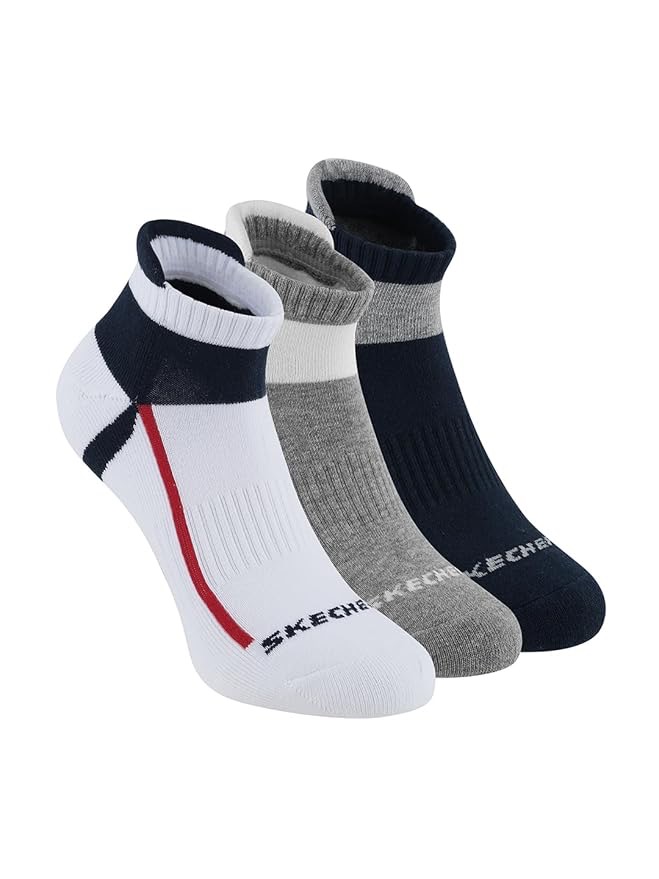


S20066ID-WBGY-3PK MENS HALF TERRY ANKLE-82% COTTON,14% POLYESTER, 2%NYLON,2% SPANDEX
Skechers Mens Cotton 3Pk Half Terry Ankle Length Socks
Original price was: ₹599.00.₹389.00Current price is: ₹389.00.
Description
An Ode to the Modern Sock: A Deconstruction of a 3-Pack of Men’s Athletic Ankles socks men cotton
In the hierarchy of garments, the sock is often relegated to an afterthought, a mere necessity, a hidden barrier between skin and shoe. Yet, to dismiss it as such is to overlook a masterpiece of textile engineering, a testament to human ingenuity, and a daily companion that bears the immense burden of our entire body weight, step after step. This document is an exhaustive exegesis of a single product: a “3PK MENS HALF TERRY ANKLE” sock. We will dissect its material composition, unravel its care instructions, explore its form and function, decode its pattern, trace its geographical origins, and ultimately, appreciate it as a singular point of convergence for global commerce, chemical science, and human need.socks men cotton
Part I: The Atomic Blueprint – Deconstructing Material Composition
The listed materials—82% COTTON, 14% POLYESTER, 2% NYLON, 2% SPANDEX—are not arbitrary numbers. They represent a carefully calibrated recipe, a symphony of natural and synthetic fibers each playing a critical role in the sock’s performance, comfort, and durability.socks men cotton
1.1 King Cotton: The 82% Foundation
Cotton is the soul of this sock. Its dominance in the blend is a deliberate choice for its unparalleled natural properties.socks men cotton
-
A Historical Legacy: The use of cotton for clothing dates back to at least 5000 BC in the Indus Valley Civilization, not far from the very country of origin for this product. Its cultivation, a meticulous process of planting, growing, harvesting, and ginning, transforms a fluffy boll into a spinnable fiber. This historical weight is woven into every thread.socks men cotton
-
The Hydrophilic Nature: At a molecular level, cotton cellulose contains a plethora of hydroxyl groups (-OH), which attract water molecules through hydrogen bonding. This makes cotton highly hygroscopic; it can absorb up to 27 times its weight in water. In a sock, this is the primary mechanism of moisture absorption, wicking perspiration away from the skin to the outer layers of the fabric, where it can evaporate. This process is fundamental to comfort, preventing the maceration of the skin and reducing friction.socks men cotton
-
socks men cottonSoftness and Breathability: The natural crimp and hollow structure of the cotton fiber create tiny air pockets within the yarn. This structure allows for exceptional air permeability, facilitating ventilation and thermal regulation. Furthermore, with each wash, cotton fibers become softer, conforming to the unique topography of the wearer’s foot, providing a custom-like feel over time.socks men cotton
-
The Drawbacks: Pure cotton has significant weaknesses. When saturated with sweat, it loses its tensile strength, becomes heavy, and can take a very long time to dry. It also lacks inherent elasticity and is prone to shrinking and losing its shape. This is why the 18% of synthetic fibers are not just additives; they are essential reinforcements.socks men cotton
1.2 The Synthetic Backbone: Polyester (14%), Nylon (2%), and Spandex (2%)
The 20th century’s polymer revolution directly addressed the shortcomings of natural fibers, giving us the tools to engineer performance textiles.socks men cotton
-
Polyester (Polyethylene Terephthalate – PET): The Workhorse.
-
Chemistry and Creation: Polyester is a synthetic polymer, primarily derived from petroleum. Through a process of polymerization, extrusion, and spinning, it is transformed into strong, consistent fibers. Its molecular chains are highly organized and hydrophobic—they repel water.socks men cotton
-
Role in the Blend: Polyester’s primary function is moisture management and durability. While it doesn’t absorb moisture, it excellently transports it. Through capillary action, the moisture absorbed by the cotton is wicked along the surface of the polyester fibers to the exterior of the sock for rapid evaporation. This keeps the foot feeling drier than cotton alone could. Furthermore, polyester fibers are incredibly strong and resistant to abrasion, stretching, and shrinking. They give the sock its structural integrity, ensuring it maintains its shape and appearance wash after wash.socks men cotton
-
-
Nylon (Polyamide): The Reinforcer.
-
A History of Strength: Invented by Wallace Carothers at DuPont in 1935, nylon was first famously used in women’s stockings. It was the first commercially successful synthetic thermoplastic polymer.socks men cotton
-
Role in the Blend: Though only 2%, nylon’s role is disproportionately critical. It is the strongest common textile fiber, boasting exceptional abrasion resistance. It is strategically placed in high-stress areas of the sock—the heel, the ball of the foot, and the toe. This tiny percentage dramatically increases the lifespan of the garment, preventing holes and wear-throughs that would quickly doom a pure cotton sock under athletic duress.socks men cotton
-
-
Spandex (Elastane): The Animator.
-
The Magic of Elasticity: Spandex (a anagram of “expands”) is a polyurethane-polyurea copolymer. Its unique segmented polymer structure allows it to be stretched to nearly 500% of its length and spring back to its original shape without degradation.socks men cotton
-
Role in the Blend: This 2% is what makes the sock fit. It provides the essential elastic recoverythat hugs the foot, provides arch support, and ensures the sock stays up on the ankle without binding or sagging. Without spandex, the sock would be a loose, baggy tube, prone to slipping, bunching, and causing blisters. It is the element of dynamic movement, the factor that allows the static textile to become an active participant in motion.socks men cotton
-
1.2 The Alchemy of Blending: Why Synergy is Key
The true genius is not in the individual fibers but in their combination. This specific 82/14/2/2 ratio represents a calculated compromise:
-
Comfort vs. Performance: It prioritizes the soft, absorbent feel of cotton (82%) while mitigating its drawbacks with the strength and wicking of polyester (14%).
-
Durability vs. Weight: It adds just enough nylon (2%) for critical reinforcement without adding unnecessary stiffness or weight.
-
Fit vs. Freedom: It includes the minimal effective dose of spandex (2%) to ensure excellent elasticity without making the sock feel constrictive or synthetic against the skin.
This blend is the industry gold standard for everyday athletic socks for a reason: it offers the best balance of comfort, performance, and value.
Part II: The Covenant of Care – “Machine Wash”
Two words, “Machine Wash,” represent a vast infrastructure of trust and technology between manufacturer and consumer.
2.1 The Physics and Chemistry of Machine Washing
A modern washing machine is a brutal environment. It subjects textiles to aggressive chemical detergents, extreme pH swings, high water temperatures, and intense mechanical agitation (spinning, tumbling, and being forced through small holes). The care label is a guarantee that this sock can survive this ordeal.
-
Colorfastness: The dyes used must be resistant to bleeding and fading when exposed to detergents and the potential presence of bleach in water.
-
Structural Integrity: The seams, the knit structure, and the elastic fibers (spandex) must withstand twisting and stretching without tearing or losing their recovery.
-
Dimensional Stability: The blend must be engineered to resist shrinking or stretching out of shape permanently. The synthetic content (polyester and nylon) is crucial here, as they are highly resistant to shrinkage compared to cotton.
2.2 The Unspoken Instructions
“Machine Wash” implies a set of best practices: washing in cold or warm water to preserve elasticity and prevent shrinkage, using mild detergents, avoiding bleach, and tumble drying on low heat. High heat is the enemy of spandex and can degrade the fibers over time. The instruction is a simplified command for a complex process, relying on consumer common sense to ensure the product’s longevity.
Part III: The Architecture of Comfort – “Socks Form: Athletic Socks” & “Half Terry Ankle”
3.1 The Athletic Sock Doctrine
“Athletic” is not just a style; it’s a functional designation. It implies a design philosophy centered on performance:
-
Cushioning: Strategic padding, especially in the heel and forefoot, to absorb impact shock during running or jumping.
-
Moisture Management: The material blend, as detailed, is chosen explicitly for this purpose.
-
Ventilation: Often features mesh-like knitting in high-heat areas (like the instep) to enhance breathability.
-
Ergonomic Fit: Designed with a left and right foot (a shaped heel pocket and toe box) for a smoother, blister-free fit. The “ankle” height provides coverage and protection from shoe abrasion while offering more breathability than a crew sock.
3.2 The “Half Terry” Construction
This is a specific knitting technique crucial to the sock’s function. “Terry” cloth is a weave characterized by loops of thread that are left uncut, creating a soft, absorbent pile surface. “Half Terry” means this looped, cushioned pile is only on the inside of the sock, specifically in the footbed area. The outside remains a smooth, flat knit. This achieves two things:
-
Internal Cushioning: The loops of yarn create a plush, comfortable layer that cushions the foot against hard surfaces and absorbs impact.
-
External Performance: The smooth exterior reduces bulk and friction between the sock and the shoe, preventing hot spots and allowing for a better fit inside the athletic shoe’s often tight confines.
Part IV: The Aesthetics of Motion – “Pattern: Striped”
The striped pattern, while seemingly trivial, serves multiple purposes.
-
Visual Appeal: It breaks up the visual monotony of a solid color, offering a classic, sporty aesthetic that has endured for decades.
-
Brand Identity: Stripes are often used in multi-packs to create color variations within the same pack, allowing for variety or coding (e.g., different colors for different days). They can also be part of a brand’s signature look.
-
Camouflage: Fine stripes can help mask minor dirt and wear better than a solid, dark color.
Part V: The Global Tapestry – “Country of Origin: India”
This single line is a window into the complex world of globalized manufacturing.
-
Textile Heritage: India has a millennia-old relationship with textile production, particularly cotton. It is one of the largest producers of cotton in the world. This deep expertise makes it a natural hub for garment manufacturing.
-
Economic Ecosystem: The production of this sock involves a vast supply chain: farming cotton in Maharashtra or Gujarat, synthesizing polyester and other polymers in industrial plants, spinning yarn, knitting, dyeing, cutting, sewing, packaging, and logistics. This provides employment to thousands, from agricultural workers to factory operators to quality control inspectors.
-
Trade and Commerce: The “Made in India” label signifies the country’s pivotal role in the global apparel export market. It speaks to competitive labor costs, established export infrastructure, and trade agreements that make such production and distribution economically viable. The journey from a Indian factory floor to a retail shelf in North America or Europe is a story of container ships, import tariffs, and just-in-time inventory systems.
Part VI: The Product as a Whole – “About this item: 3PK MENS HALF TERRY ANKLE”
This final line is the product’s ultimate identity.socks men cotton
-
3PK (3-Pack): The economics of bundling. It reduces per-unit packaging and marketing costs, offers value to the consumer, and capitalizes on the fact that socks are a consumable good that needs frequent replacement. It encourages brand loyalty—if you like one pair, you have three.socks men cotton
-
MENS: Signifies a sizing and last (a foot model) designed for the average male foot, which is typically wider and larger than the average female foot. The styling is also likely more masculine, using darker, more neutral colors.socks men cotton
-
HALF TERRY ANKLE: The complete technical description, as detailed in Section III.
Conclusion: The Sock as a Microcosm
What appears to be a simple, disposable commodity is, upon inspection, a remarkable artifact. It is a narrative of:socks men cotton
-
Botany and Geology: The cotton plant and the petroleum origins of its synthetic companions.socks men cotton
-
Chemistry: The polymerization of plastics and the molecular bonding of water.socks men cotton
-
Physics: The principles of elasticity, moisture wicking, and impact absorption.socks men cotton
-
Engineering: The mechanical knitting of yarn into a complex, three-dimensional structure.socks men cotton
-
Economics: The global supply chain that makes its production and sale profitable.socks men cotton
-
Design: The ergonomic and aesthetic choices that prioritize human comfort and preference.
The humble sock is a testament to humanity’s relentless drive to improve even the most mundane aspects of existence. It is a product that, quite literally, supports us every step of the way. To understand its composition is to understand a small but significant piece of the modern world.socks men cotton
In the vast and intricate tapestry of human attire, few garments are as universally essential yet perpetually overlooked as the sock. It is a barrier, a mediator, a cushion, and a microclimate manager. It operates in the dark, unseen, bearing the immense, repetitive load of our entire body weight, absorbing shock, managing moisture, and enduring friction that would otherwise render our feet raw and useless. To dismiss a sock as a simple tube of fabric is to overlook a profound achievement in textile engineering, material science, and global logistics.socks men cotton
This document is an exhaustive exegesis of a single product listing: a “3PK MENS HALF TERRY ANKLE” sock with a specific material composition. We will dissect this description layer by layer, transforming each term into a portal to a wider world of understanding. We will explore the botany of cotton, the organic chemistry of polymers, the mechanical engineering of knitting machines, the economics of global trade, and the sociology of clothing care. This is the story of how the world comes together to clothe a single foot.socks men cotton
Volume I: The Material Composition – A Symphony of Fibers
The alphanumeric string “82% COTTON, 14% POLYESTER, 2% NYLON, 2% SPANDEX” is not a random assortment. It is a precise recipe, a carefully calibrated formula born from decades of research and consumer feedback. Each percentage represents a strategic decision, balancing comfort, performance, durability, and cost.socks men cotton
Chapter 1: King Cotton – The 82% Foundation (Approx. 1500 words)
Cotton is the soul of this sock. Its dominance is a testament to its historical legacy and its unmatched natural properties.
-
1.1 A Historical Legacy Woven in Thread: The story of cotton begins millennia ago. Evidence of its use in cloth dates back to 5000 BC in the Indus Valley Civilization, in regions proximate to modern-day India—the very origin of our subject sock. From there, it spread to ancient Egypt, Persia, and eventually the world. The Cotton Gin, invented by Eli Whitney in 1793, revolutionized its processing, fueling the Industrial Revolution and irrevocably altering global economics and, tragically, the institution of slavery. This historical weight is literally woven into every thread; wearing cotton is to wear history.socks men cotton
-
1.2 The Botany of Comfort: Gossypium hirsutum: Most modern commercial cotton comes from the species Gossypium hirsutum, or upland cotton. The journey from field to fiber is meticulous:socks men cotton
-
Cultivation: Cotton is a shrub requiring a long, sunny growing season. It is planted, grown, and eventually, the bolls—the seed pods—burst open to reveal the fluffy, white lint.socks men cotton
-
Harvesting: Once done by hand, this is now largely mechanized with giant cotton pickers that strip the bolls from the plants.socks men cotton
-
Ginning: The harvested cotton is taken to a gin, where saws and rollers separate the valuable lint fibers from the seeds (which are used for cottonseed oil and animal feed).socks men cotton
-
Baling: The cleaned lint is then compressed into enormous bales, each weighing nearly 500 pounds, for shipping to spinning mills.socks men cottonsocks men cotton
-
-
1.3 The Physics and Chemistry of a Fiber: Under a microscope, a cotton fiber looks like a twisted, flattened ribbon. This natural convolution, called a “convolution,” is key to its spinability. Crucially, the fiber is a single plant cell that is mostly cellulose, a natural polymer.socks men cotton
-
Hygroscopic Nature: The cellulose molecule is replete with hydroxyl groups (-OH). These form hydrogen bonds with water molecules (H₂O), making cotton incredibly hydrophilic. It can absorb up to 27 times its own weight in water. In a sock, this is the primary mechanism for moisture absorption, wicking perspiration away from the skin to the outer layers of the fabric, where it can evaporate. This is the fundamental process of keeping the foot dry and preventing maceration and blister-causing friction.socks men cotton
-
Breathability: The natural hollow core (lumen) of the cotton fiber and the air pockets between the twisted convolutions create a structure that allows for exceptional air permeability. This facilitates ventilation and helps regulate temperature, preventing the foot from overheating.socks men cotton
-
Softness and Drapability: Cotton fibers are relatively short (staples) compared to synthetic filaments. When spun into yarn and woven into fabric, these short fibers create a surface that feels soft against the skin. With each wash, the fibers become even softer, conforming to the unique topography of the wearer’s foot.socks men cotton
-
-
1.4 The Drawbacks of a Pure Cotton Sock: For all its virtues, a 100% cotton sock is a poor choice for athletics. When saturated, it loses tensile strength, becomes heavy and waterlogged, and dries very slowly. A wet sock leads to cold feet, increased friction, and a higher risk of blisters and fungal infections. It also lacks elasticity, is prone to shrinking, and will bag out over time. This is why the remaining 18% of synthetic fibers are not mere additives; they are essential, performance-enhancing reinforcements.socks men cotton


Reviews
There are no reviews yet.