
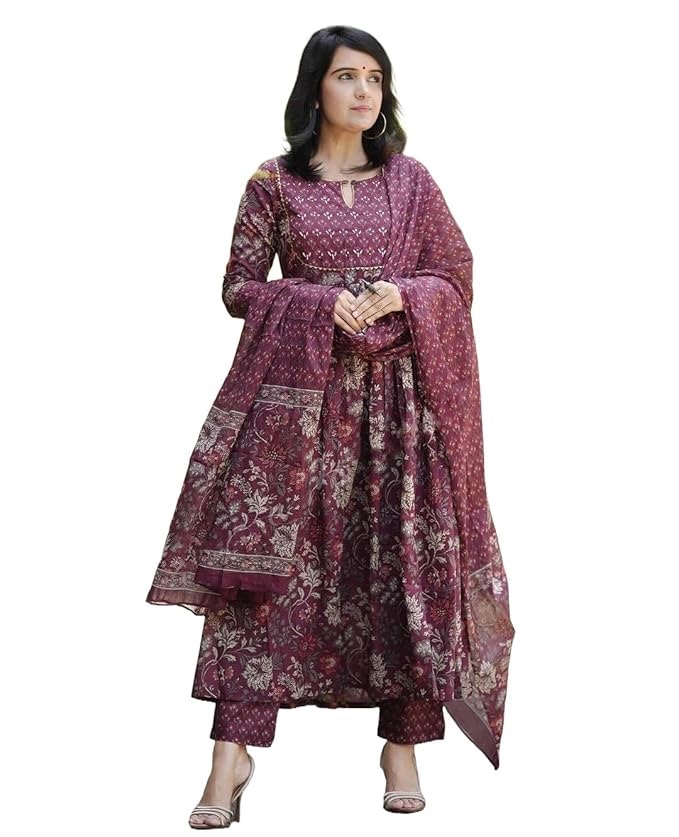


We presents a wide range of women’s apparel made up of skin-friendly fabric to offer better comfort.
Alvami Women Printed Kurta and Pant Set with Dupatta
Original price was: ₹888.00.₹799.00Current price is: ₹799.00.
Description
The Maroon Anarkali: A Deep Dive into an Icon of Indian Elegance printed kurta women
The description provided—a mere list of attributes and promotional copy—belies the profound story contained within a single garment. It is a portal into a world of cultural heritage, textile science, artistic expression, and sartorial philosophy. This document will expand upon that brief snippet to explore the intricate universe of a maroon, floral-printed, viscose Anarkali kurta set. We will dissect its components, trace its historical lineage, understand its material soul, and appreciate its versatile essence, transforming a simple product listing into a narrative of craftsmanship and style.
Introduction: More Than Just an Outfit
At first glance, the item is defined as a “Kurta and Pant set With Dupatta” in “Maroon” made of “Silk” (a point we will critically address) with a “Floral” pattern. But this is like describing a symphony as a “song with violins.” This ensemble is a coordinated ecosystem of garments, each piece playing a vital role in creating a harmonious whole. The choice of an Anarkali silhouette immediately signals drama and grace. printed kurta women
The 3/4 sleeve and round neck suggest a blend of modesty and modern practicality. The maroon colour whispers of royalty and passion, while the floral pattern connects it to nature’s timeless beauty. The claim of versatility—from casual office wear to grand weddings—speaks to the unique ability of Indian ethnic wear to transcend situational boundaries. This is not merely clothing; it is a tool for self-expression, rooted in tradition and tailored for contemporary life.printed kurta women
Deconstructing the Ensemble: The Trinity of the Outfit
The Indian kurta set is a triumvirate of style, where the sum is far greater than its parts. Understanding each component is key to appreciating the whole.printed kurta women
1. The Kurta: The Centerpiece of Narrative
The kurta is the undisputed focal point of the ensemble. The term “kurta” itself originates from the Sanskrit word kurtaka, meaning a sleeved garment. It has evolved over millennia, influenced by Mughal aesthetics, Persian cuts, and regional Indian tailoring traditions.printed kurta women
-
The Anarkali Silhouette: A Dance of Drama and History: The style specified here is the “Anarkali,” a name that carries with it a whisper of legend and romance. It is famously attributed to a courtesan named Anarkali in the court of Mughal Emperor Akbar. The silhouette is designed to emulate the delicate, flowing petals of a pomegranate blossom (anar meaning pomegranate, kali meaning bud).printed kurta women
-
Its defining characteristic is its construction: it is typically a long, flowy tunic that is fitted from the bodice down to the waist or hips and then flares out dramatically into a voluminous, floor-length skirt. This creates a majestic, bell-shaped profile that moves beautifully with the wearer, offering a sense of grandeur and femininity. The flare can be achieved through the use of panels (often four, six, or even more) or through circular cuts. The Anarkali is more than just a cut; it is a statement.printed kurta women
-
It evokes a sense of old-world charm and regality, making the wearer the center of attention in any gathering.printed kurta women
-
The Neckline: The Round Neck (Crew Neck): The “Round Neck” or crew neck is a classic and supremely versatile choice. Its simplicity is its greatest strength. Unlike a V-neck or a keyhole neckline, the round neck offers a sense of completeness, modesty, and understated elegance.printed kurta women
-
It provides a perfect canvas for the wearer to accessorize. A statement necklace lies beautifully against it, while a simpler pendant or just a pair of earrings allows the fabric and print of the kurta itself to take precedence. It frames the face softly and is universally flattering, avoiding the sharp angles of other necklines. Its construction is also simpler, making it a staple in both high-end and mass-market ethnic wear.printed kurta women
-
The Sleeves: The 3/4 Sleeve: The “3/4 Sleeve” length, ending somewhere between the elbow and the wrist, is arguably one of the most elegant and practical sleeve designs. It offers a perfect balance between coverage and breathability. It provides enough modesty for formal and traditional settings while exposing the forearm, which is often considered a graceful part of the arm.printed kurta women
-
This length is ideal for showcasing bracelets (kadas, bangles, or watches) without them being completely hidden or interfering with long cuffs. It is functional for eating and moving around comfortably, avoiding the need to constantly adjust full-length sleeves. In terms of aesthetics, the 3/4 sleeve breaks the monotony of the garment’s length, adding a distinct horizontal design element that enhances the overall proportions of the outfit.printed kurta women
-
The Length: Standard/Casual Length: The description uses the terms “Standard Length” and “Casual” somewhat interchangeably. In the context of an Anarkali, this typically means the hemline falls to the calf or just above the ankle, rather than being a full-floor-length gown.printed kurta women
-
This “standard” or “casual” length is immensely practical. It prevents the garment from dragging on the ground, making it suitable for daily wear, office environments, and less formal events. It allows for easier movement and is less cumbersome than its full-length counterpart, while still retaining the essential flared silhouette that defines the Anarkali style.printed kurta women
2. The Bottom: The Supporting Pillar – The Pant
The description simply states “Bottom :- Pant.” In the context of Indian ethnic wear, this almost certainly refers to straight-cut trousers or churidars that have been adapted into a more relaxed, pajami-style fit.printed kurta women
-
Straight-Leg Pajami/Pant: These are tailored to be loose and comfortable through the hips and thighs, tapering slightly or running straight down to the ankle. They are designed to be worn with kurtas that are long and flared, like the Anarkali, as their simplicity balances the volume on top.printed kurta women
-
They provide a clean, streamlined look from the waist down, ensuring the focus remains on the kurta. The elasticated or drawstring waistband is a common feature, prioritizing comfort without sacrificing style. They are easy to wear, move in, and sit in for extended periods, contributing significantly to the outfit’s “Casual” and “Office wear” credentials.printed kurta women
-
Contrast with Other Bottoms: It is worth noting what this pant is not. It is not a:
-
Churidar: These are tight-fitting trousers that gather at the ankle, creating concentric folds. They are more traditional and formal.printed kurta women
-
Salwar: These are loose, pleated trousers that taper dramatically at the ankle (a Punjabi cut).printed kurta women
-
Palazzo: These are extremely wide-legged pants, which would add even more volume to the already voluminous Anarkali.
The choice of a simple pant indicates a design intention towards modernity, ease, and versatility.printed kurta women
-
3. The Dupatta: The Final Brushstroke – The Essence of Grace
No traditional Indian kurta set is complete without its dupatta. This long, rectangular scarf is the quintessential accessory that ties the entire look together, both literally and figuratively. It is a symbol of grace, tradition, and completion.printed kurta women
-
Function and Form: The dupatta serves multiple purposes. Historically, it was a modesty garment. Today, it is primarily an aesthetic element. It adds a layer of texture, movement, and colour. Draped over the shoulders, pinned at one shoulder, or wrapped around the neck, the dupatta introduces an element of fluid dynamism to the outfit. As the wearer moves, the dupatta flows, creating a captivating visual trail.printed kurta women
-
Material and Print: In this set, the dupatta would be made from the same 100% viscose material and feature the same maroon floral print as the kurta, creating a cohesive and coordinated look. Its lightweight nature allows it to drape softly and flow effortlessly.printed kurta women
-
Styling Possibilities: The dupatta is the most versatile part of the set. It can be styled in a dozen ways:
-
Classic Drape: Simply thrown over both shoulders.printed kurta women
-
One-Shoulder Drape: Pinned at one shoulder for an asymmetrical look.printed kurta women
-
Front Pleated: Neatly pleated and pinned at the shoulder for a formal effect.printed kurta women
-
Saree-Style: Draped like a pallu over one shoulder and around the waist.printed kurta women
-
Scarf-Style: Loosely wrapped around the neck.
-
Accent Piece: Simply carried over the arm for a subtle touch.
The dupatta is what transforms the outfit from “casual” to “party” or “wedding” ready based on how it is styled.
-
The Heart of the Matter: Material – Viscose vs. “Silk”
This is the most critical clarification from the original description. The product tag states “100% Viscose,” while the marketing copy says “Product Material :- Silk.” This is a common point of confusion and marketing sleight of hand in the textile industry.
Viscose: The “Artificial Silk”
-
What it is: Viscose is a semi-synthetic fiber. It is not synthetic like polyester (which is petroleum-based), nor is it natural like cotton or silk (grown or produced directly). It is made from regenerated cellulose, most commonly derived from wood pulp (e.g., from bamboo, beech, or pine trees) or sometimes from cotton linters. The pulp is treated with chemicals to create a viscous solution, which is then forced through a spinneret into a bath to form fibers. This process is known as the viscose process.
-
Why it’s called “Artificial Silk”: Viscose was invented in the late 19th century as a cheaper alternative to silk. It successfully mimics several of silk’s most desirable properties: its brilliant sheen, its fluid drape, its soft and smooth hand-feel, and its ability to absorb dyes beautifully, resulting in vibrant, rich colours like the described “Maroon.” To the untrained eye and hand, a high-quality viscose garment can be indistinguishable from silk.printed kurta women
-
Properties and Care:
-
Pros: Breathable, highly absorbent, drapes excellently, dye-rich colours, soft, lightweight, and biodegradable.printed kurta women
-
Cons: It can be weaker when wet, prone to shrinking if machine-washed or tumble-dried, and can wrinkle easily. It often requires gentle hand washing in cold water or dry cleaning to maintain its shape and finish.printed kurta women
-
The “Silk” Misnomer: Using the word “Silk” in the description is a marketing tactic known as “artificial silk” or “art silk.” It is intended to conjure the luxury and appeal of real silk to attract buyers, while the actual material is the more affordable and commonly used viscose. For care purposes, it is imperative to follow instructions for 100% Viscose, not silk. Ironing should be done on a cool setting, and aggressive washing should be avoided.
-
Real Silk: A Benchmark of Luxury
-
What it is: Silk is a natural protein fiber produced by silkworms to form their cocoons. The process of harvesting these cocoons and reeling the filaments into yarn is labor-intensive and ancient, contributing to its high cost. The most prized form is Mulberry silk.
-
Properties: Silk is the strongest natural fiber. It has a natural shimmering appearance due to the triangular prism-like structure of the fiber, which refracts light. It is hypoallergenic, temperature-regulating (cool in summer, warm in winter), and incredibly durable if cared for properly. The drape of silk is luxurious and heavy, distinct from the lighter drape of viscose.
-
Why it’s unlikely here: Given the price point implied by a mass-produced item with size ranges from S to XXL and its origin in a major manufacturing hub like India, it is highly improbable that the set is made of real silk. Real silk garments are typically marketed explicitly as such and command a significantly higher price.
Conclusion on Material: The garment is almost certainly 100% Viscose. This is not a negative; it is a fantastic material that offers a luxurious look and feel at an accessible price point, with excellent drape and colour vibrancy. However, the buyer must be aware of its care requirements to ensure the longevity of the outfit.
The Language of Design: Pattern, Colour, and Fit
The Floral Pattern: A Timeless Motif
The “Floral” pattern is the most enduring and beloved print in fashion history, across all cultures. In Indian wear, it holds special significance.
-
Symbolism: Flowers are universal symbols of beauty, growth, femininity, and celebration. In Indian art and textiles, specific flowers like the lotus (purity), the rose (love), and the mango (prosperity) carry deep cultural and religious meanings.
-
Aesthetic Appeal: A floral print on a flowing Anarkali creates a romantic, graceful, and organic aesthetic. The repetition of the pattern across the vast canvas of the kurta creates rhythm and visual interest. The scale of the print can vary—from small, delicate buds to large, bold blossoms—each creating a different effect. On a maroon background, the floral print is likely executed in contrasting colours (whites, golds, pinks, or greens) to make the pattern pop, creating a rich and visually captivating garment.
The Maroon Colour: Depth and Passion
Colour is never arbitrary in Indian clothing. Maroon is a deep, rich, red-brown hue that is powerful and versatile.
-
Cultural Resonance: It sits within the red family, which is the quintessential colour of celebration in Indian culture—symbolizing love, passion, prosperity, and matrimony. However, maroon is a more subdued, mature, and sophisticated shade than bright red. It carries the gravitas of red without its overwhelming brightness, making it suitable for a wider range of ages and occasions.
-
Psychological Impact: Maroon is perceived as elegant, confident, and grounded. It is not a frivolous colour; it has weight and seriousness, which aligns with the “Office wear” descriptor. Simultaneously, its warmth and richness make it festive enough for a “Wedding” or party.
-
Universally Flattering: This deep, warm tone is flattering on a wide spectrum of skin tones, from very fair to very deep, which is crucial for a garment produced in a country with immense diversity like India.
The Regular Fit: The Philosophy of Comfort
The “Regular” fit, also known as a “standard” or “relaxed” fit, is a deliberate design choice that prioritizes comfort and inclusivity.
-
What it Means: It indicates that the garment is not body-hugging (like a slim or fitted cut) nor overly loose (like a baggy or oversized cut). It follows the natural lines of the body without constricting it. For an Anarkali, this means the bodice is fitted but not tight, and the flare begins in a way that allows for ease of movement.
-
The Indian Ethos: This aligns with the traditional Indian approach to clothing, where comfort and freedom of movement are paramount. It is designed to be worn for long hours, while sitting on floors, crossing legs, and engaging in various activities. It is a democratic fit that can accommodate different body types with minimal need for alterations, making it ideal for the mass market.
The Scale of Production: Sizing and Origin
Sizes: S, M, L, XL, XXL – The Standard Spectrum
The availability of this standard five-size range indicates that this is a ready-to-wear, mass-produced garment. It is designed to cater to the largest possible segment of the market. The note “(All Regular Size Avalible)” [sic] suggests that the sizing follows common Indian size charts, which can differ slightly from Western sizing. A savvy buyer would always seek out the brand’s specific size chart (measurements for bust, waist, hip, and length) to ensure a perfect fit, as a “Medium” can vary significantly between manufacturers.
Country of Origin: India – The Epicenter of Ethnic Fashion
The “Made in India” tag is not just a label; it is a hallmark of authenticity and expertise.
-
Textile Heritage: India has a millennia-old history of textile production, dyeing, and embroidery. Cities like Delhi, Mumbai, Surat, and Jaipur are massive hubs for the manufacture of ethnic wear. The entire supply chain—from weaving the fabric to printing, cutting, stitching, and finishing—is deeply established and highly specialized within the country.
-
Expertise: The craftsmanship involved in creating a well-tailored Anarkali set—managing the flare of the kurta, the precision of the print alignment, the finishing of the seams—is a skill possessed by a vast workforce in India. Buying a garment born in its cultural home often assures a certain level of inherent understanding of the product’s form and function.
-
Economic and Cultural Context: The Indian textile and apparel industry is one of the largest in the world, providing employment to millions and contributing significantly to the economy. This garment is a product of that immense ecosystem.
Conclusion: The Synthesis of Elements
The product description we began with—”100% Viscose,” “3/4 Sleeve,” “Floral,” “Maroon,” “Anarkali,” “India”—is a code. When deciphered and expanded, it reveals a meticulously designed garment that is a testament to modern Indian fashion. It successfully merges traditional inspiration (the Anarkali cut, the dupatta) with contemporary needs (the practical length, the comfortable pant, the versatile fit). It leverages the advantages of modern textiles (viscose for drape and colour) while echoing the luxury of traditional ones (silk). It is a product of a robust manufacturing ecosystem, designed for a discerning, versatile, and global audience.
This maroon floral Anarkali set is more than just an item of clothing; it is a portable piece of culture, a canvas for personal expression, and a celebration of the enduring, evolving beauty of Indian ethnic wear. It proves that elegance can be comfortable, tradition can be modern, and a single outfit can indeed tell a thousand stories.


Reviews
There are no reviews yet.